
Chronic vomiting in dogs and cats almost always has a specific cause underneath it, even when the surface picture looks vague. A pet who throws up once and bounces back has usually cleared something irritating from the stomach, but a pet who keeps cycling through vomiting for weeks cannot fix it alone. Likely culprits include food intolerance, inflammatory bowel disease, parasites, pancreatitis, and chronic kidney or liver disease, and the right answer changes the treatment plan completely. Pinpointing the cause is a stepwise process that usually starts with bloodwork and X-rays, especially when weight loss, appetite shifts, or intermittent diarrhea are part of the picture.
Sixes Animal Hospital at Bridgemill in Canton works through chronic GI cases with shared decision-making. Our in-house lab and digital radiology get the first answers back fast, and from there we guide a structured food trial or turn to biopsy when the cause is still hiding. If your pet has been vomiting on and off, get in touch with our team and we will map out what comes next.
The Short Version
- A single vomiting episode that resolves on its own is usually nothing, but a pattern that keeps returning over weeks or months points to a specific underlying cause that needs to be found.
- Chronic vomiting paired with weight loss, appetite changes, increased thirst, or intermittent diarrhea signals a problem one medication is unlikely to fix alone.
- The workup follows a logical order: bloodwork and imaging, then a strict diet trial, and endoscopy or biopsy only when earlier steps leave the cause hidden.
- Possible causes range from food intolerance and swallowed objects to kidney trouble and inflammatory bowel disease, and finding the answer sometimes takes more than one visit.
When Should Vomiting Send You Straight to the Vet?
Some vomiting cannot wait for an appointment. Come in immediately if your pet is vomiting blood, retching without producing anything, showing a swollen or painful belly, or unable to keep even water down. Those signs point toward bleeding, obstruction, bloat, or rapid dehydration, and every one of them gets worse with time rather than better.
Here is the full list worth acting on now:
- Vomiting blood, whether bright red or dark and grainy.
- A distended, painful, or bloated belly, especially in deep-chested dogs.
- Unproductive retching, where a dog heaves repeatedly but nothing comes up.
- Inability to keep even water down, which leads to dehydration fast.
- Severe lethargy or collapse alongside the vomiting.
- Vomiting in a very young or very old pet who also seems unwell.
If any of these show up, reach us for urgent care for your dog or cat in Canton. We see urgent and emergency cases during regular hours; for anything overnight or on a day we are closed, head to the nearest veterinary ER.
Reading the Episodes: Is This Vomiting Worth a Second Look?
Not every episode means trouble, but the pattern matters more than any single incident. A pet who vomits once and then eats dinner normally is different from one who throws up every few days for a month. Reading those episodes by appearance, frequency, and urgency gives you and our team a real head start before any test is run.
The concern rises with aging pets, because the organ problems that arrive with age frequently announce themselves through chronic vomiting first. Older cats in particular sit near the top of the list, where conditions like an overactive thyroid, kidney disease, and inflammatory bowel disease grow more common.
What Can the Color and Frequency of Vomit Tell You?
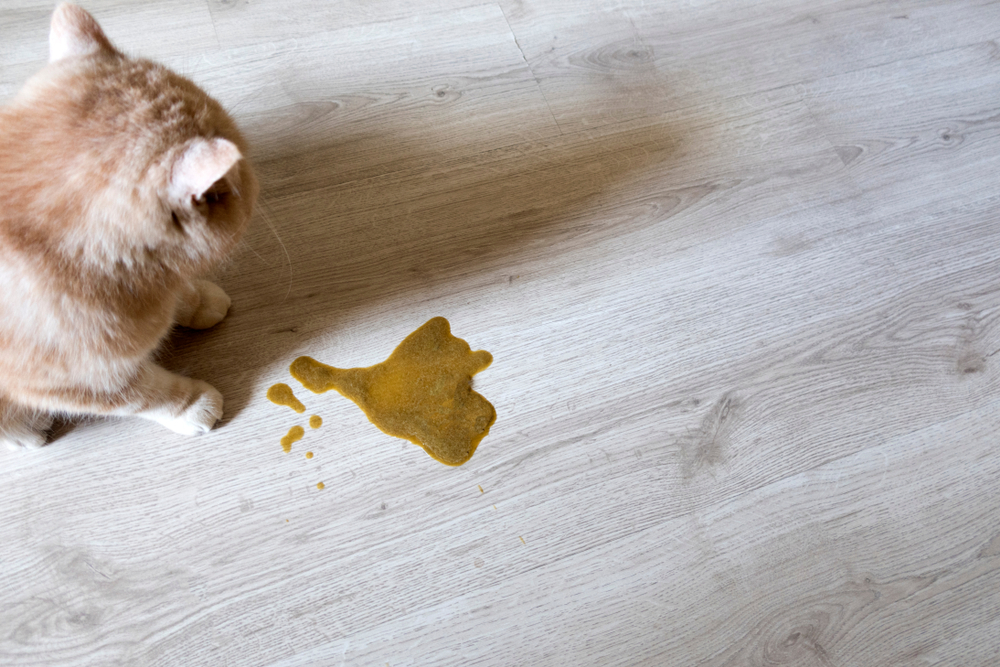
What comes up, and how often, carries clinical information before testing even begins. Yellow bile, undigested kibble, and foamy white liquid each point somewhere different, so it’s worth a quick phone photo before you wipe it up to show us what the vomit looks like.
Here is a quick guide to the most common types and what each may suggest:
| What you see | What it may point toward |
| Yellow or green bile | An empty stomach, bilious vomiting, or gallbladder involvement |
| Undigested food, brought up passively | Possible regurgitation rather than true vomiting |
| Dark, coffee-ground material | Digested blood from the stomach or upper intestine |
| Bright red blood | Fresh bleeding higher up, worth a prompt call |
| Foamy white liquid | Stomach irritation or an empty, acidic stomach |
One distinction is worth making early. Undigested food that simply falls back out without heaving may not be vomiting at all but regurgitation, which points toward the esophagus rather than the stomach and leads down a very different diagnostic path.
Which Signs Mean It Is Time to Book an Appointment?
The line between watchful waiting and picking up the phone usually comes down to how long it has been going on and what else has changed. Vomiting that stretches across several weeks earns an appointment, even when your pet seems otherwise happy. So do a handful of other signals:
- Frequent hairballs in cats: A cat bringing up more than one hairball a month is not the harmless quirk it seems; it can flag a digestive tract that is not moving hair through the way it should.
- Unexplained weight loss: A shrinking waistline without a diet change is one of the more telling signs that something needs attention.
- Increased thirst or urination: More trips to the water bowl and the litter box can point toward organ involvement.
- Low energy or a dip in appetite: A pet who is off their food or unusually flat alongside the vomiting deserves a look.
- Concurrent diarrhea: Vomiting and loose stool together suggest the whole GI tract is unhappy.
Could Something Simple Be Making My Pet Sick?
Sometimes, yes. Two everyday contributors look identical to medically caused vomiting and are worth ruling out before assuming the worst: eating too fast, and chronic stress. Both are common, both are easy to miss, and the fixes are simple enough that they cost you nothing to try while the rest of the workup is underway.
Does Eating Too Fast Cause Vomiting?
Picture the pet who inhales dinner in eight seconds flat, then brings it right back up barely touched. That is the classic “scarf-and-barf”, common in multi-pet households and in pets who once competed for food. Slow feeders that force a pet to work for each bite often stop the cycle on their own. Feeding pets in separate rooms and offering smaller, more frequent meals help, too.
Can Anxiety Upset My Pet’s Stomach?
Chronic anxiety is an underappreciated driver of GI symptoms, especially in cats. A disrupted routine, a new baby, or ongoing household tension can all upset a sensitive stomach, and stress in cats frequently shows up as vomiting that looks no different from the medically caused kind. Watch for other signs of stress: hiding more than usual, overgrooming to the point of thin fur, or shifts in how your pet interacts with the family.
What Are Medical Causes of Vomiting in Pets?
Chronic vomiting is rarely a single-system problem, which is why an accurate diagnosis matters: the right treatment depends entirely on the right cause. The categories below cover the main possibilities, but the list is not exhaustive, and finding the true culprit can take more than one visit and more than one test. We keep working the problem with you until the picture comes clear.
Can Food and Diet Cause My Pet to Vomit?
Food is one of the most common contributors to chronic vomiting, and often one of the last things a pet family thinks to question. Two patterns stand out:
- The food itself: An allergy involves the immune system reacting to a protein, while an intolerance is more of a digestive mismatch, but both drive ongoing symptoms. Rotating flavors and brands makes the trigger nearly impossible to pin down.
- Something they ate on a walk: Dietary indiscretion covers raiding the trash or swallowing an item that was never food. A small toy or wad of fabric that lodges without fully blocking the gut can cause a partial obstruction, producing on-and-off vomiting instead of the sudden emergency you might expect. When imaging shows something that needs to come out, we remove it surgically.
Can an Organ Problem Make My Pet Vomit?
Vomiting is not always a stomach problem. Several systemic conditions trigger nausea as a downstream effect, which is why treating the GI symptoms alone rarely produces lasting improvement. The key contributors include:
- Chronic kidney disease: Failing kidneys make a pet nauseous as the waste they can no longer clear builds up.
- Liver disease: The liver can struggle quietly, with vomiting as one of the earliest clues.
- Gallbladder disease: Problems with the gallbladder disrupt how the body processes toxins, and nausea often follows.
- Hyperthyroidism in cats: An overactive thyroid speeds up the whole system and commonly announces itself with vomiting and weight loss in older cats.
- Pancreatitis: Inflammation of the pancreas disrupts digestion and provokes nausea that anti-vomiting medication alone will never fully settle.
What GI Diseases Cause Ongoing Vomiting?
Once systemic causes are ruled out, attention turns to conditions originating in the GI tract itself. Telling them apart matters, because the treatments differ significantly:
- Inflammatory bowel disease: Chronic inflammation in the gut lining is one of the most common findings once other causes are cleared.
- Intestinal lymphoma: A cancer of the gut that can look remarkably like IBD on the surface, which is why tissue sampling matters.
- Gastric ulcers: Erosions in the stomach lining, sometimes bringing up dark, digested blood.
- Bilious vomiting syndrome: A dog that throws up yellow bile first thing in the morning may fit this pattern, which often improves with a late-night snack.
- Pyloric stenosis: A narrowing at the stomach’s exit slows the passage of food and can trigger repeated vomiting.
- Gastric cancer: Less common but serious, particularly in older pets with persistent symptoms.
What Does the Diagnostic Workup Actually Involve?
The workup starts with a thorough history and a hands-on physical exam, then moves to baseline diagnostics that build a picture from the inside out. Nothing about it is mysterious, and each test answers a different question.
Bloodwork screens organ function, blood cell counts, and the clues pointing toward systemic disease. A urinalysis shows how well the kidneys are concentrating, a clue a routine blood panel can miss entirely. Pets with annual wellness bloodwork on file give us a quiet advantage here, since an earlier picture to compare against makes a shift in values far more meaningful than a single snapshot.
A fecal check looks for intestinal parasites, and that step earns its keep here in Georgia, where our long warm season keeps hookworms and roundworms cycling nearly year-round instead of dying back over a hard winter.
Imaging comes next. An x-ray, sometimes paired with a barium study, shows the size, shape, and position of the organs and can catch an obstruction. Ultrasound answers a different question: it reads the layered wall of the intestines and the texture of soft tissue, often catching thickening or masses a flat image cannot. If ultrasound is needed, we can refer you to a trusted partner and then act on the results back here in our hospital. We run in-house lab work and x-ray imaging so the first answers come back promptly.
How Does a Diet Trial for Chronic Vomiting Work?
When the baseline workup comes back clean, a structured diet trial becomes the next real test. We swap your pet onto a novel or hydrolyzed protein and they eat that only with zero exceptions, watching whether the vomiting settles.
A novel protein diet uses a meat the pet has never eaten, so the immune system has nothing to react to. A hydrolyzed diet breaks ordinary proteins into pieces too small for the body to recognize. The catch, and it is the whole game, is strict compliance: no treats, no table scraps, no flavored medications, and no sharing food with other pets. A single stolen bite can undo weeks of work. Over-the-counter limited-ingredient foods are not reliable for a diagnostic trial either, since manufacturing cross-contamination lets trace proteins sneak in and defeat the purpose.
When Are Endoscopy and Biopsy Needed?
When initial testing and a diet trial have not identified the cause, the next step is looking directly at the tissue itself. Two procedures do that, and each has a role, so the choice comes down to what the earlier testing has already shown us.
What Is Endoscopy?
Endoscopy threads a flexible camera into the stomach and upper intestine under anesthesia, letting a vet see the lining directly and pinch off tissue samples without a single incision, so most pets bounce back the same day. Because it calls for specialized equipment, we coordinate this procedure through a trusted referral partner and stay involved in the plan.
What Does GI Surgery and Biopsy Reveal?
Exploratory surgery trades that convenience for depth, letting us examine the organs by hand and take a full-thickness biopsy that captures disease hiding deeper in the wall than an endoscopic sample can reach, from several points along the GI tract at once. The open approach makes sense when imaging flags an abnormality, when full-thickness samples are needed, or when a blockage or mass has to be removed. We provide abdominal surgery and tissue sampling for cases that call for it.
What Do Biopsy Results Show?
Telling IBD apart from intestinal lymphoma, other GI cancers, infections, and various inflammatory patterns comes down to histopathology, the study of the biopsy samples under a microscope. That distinction is not academic. It changes everything, because the treatments differ entirely, and an accurate tissue diagnosis lets us aim therapy at what is actually there rather than treating by trial and error.
What Does Treatment Look Like Once We Have Answers?
Treatment follows the diagnosis, and three main pathways tend to emerge depending on what the workup finds. Here is how they compare:
| What the workup finds | Where treatment focuses |
| Food-responsive vomiting | Staying on the diet that worked, with firm household rules |
| Inflammatory bowel disease | Anti-inflammatory or immunosuppressive medication plus diet support |
| A systemic organ disease | Managing the underlying condition driving the nausea |
Whichever path fits, we map out the plan based on the results and a conversation with you, then adjust it based on how your pet is actually doing. The pattern worth noticing is that none of these are quick fixes. Food-responsive cases hinge on household discipline more than medication, IBD is managed rather than cured, and a systemic illness only lets go of the GI symptoms once the underlying organ condition steadies.
What Families Ask Us About Chronic Vomiting
Is it normal for my cat to vomit hairballs regularly?
An occasional hairball is normal, but a cat coughing one up more than about once a month is worth a closer look. Frequent hairballs can mean the digestive tract is not moving hair through the way it should, which sometimes points to an underlying GI problem rather than a grooming habit. If the pattern picks up or comes with weight loss or reduced appetite, bring it to our attention.
My pet vomits but seems totally fine otherwise. Should I still worry?
Possibly, yes. Plenty of pets with chronic GI conditions or early organ disease act normal between episodes. The vomiting pattern matters more than how your pet seems in the moment. If it has been happening on and off for a few weeks or longer, that persistence alone is reason enough to have it checked.
How long does a diet trial take to show results?
A proper diet trial usually runs 8-12 weeks, and patience is part of the process. The immune and digestive systems need time to settle once the triggering ingredient is gone, so results rarely appear overnight. The single most important factor is strict compliance: one treat, one flavored pill, or a bite of a housemate’s food can reset the clock.
Let’s Trade Guesswork for a Real Answer
Managing a pet who keeps getting sick without knowing why is exhausting, and the worry is real. The good news: a methodical, step-by-step approach almost always gets to an answer, and you never have to sort through it alone. We are committed to working the problem thoroughly, keeping you in the loop, and building a plan you feel good about.
If your pet has been vomiting on and off, book a visit and we will map out the next step together. You can also reach out to our team with any questions along the way.

Leave A Comment